Tuesday, April 27, 2010

Rebecca (1940)

Director: Alfred Hitchcock
Cast: Laurence Olivier, Joan Fontaine, George Sanders, Judith Anderson
Genre: Drama, Romance, Thriller, Mystery
Other Nominees: All This and Heaven Too, Foreign Correspondent, The Grapes of Wrath, The Great Dictator, Kitty Foyle, The Letter, The Long Voyage Home, Our Town, The Philadelphia Story

“Last night, I dreamt I went to Manderley again. I stood by the iron gate leading to the drive, and for a while I could not enter for the way was barred to me. Then, like all dreamers, I was possessed of a sudden with supernatural powers and passed like a spirit through the barrier before me..”

What a great opening to a film! I defy anyone to watch this opening scene and not be hooked. The narrator who speaks these lines is the second Mrs. de Winter, lady of this house, and as she tells us of her dream we see it with out own eyes on screen. The camera takes us through the iron gate and down a twisting driveway overgrown with brush and weeds. The fog thickens for some time increasing the eeriness and when it clears standing before us are the ghostly ruins of Manderley, a great estate house in Southern England. In her dream the moon plays tricks on Mrs. de Winter and various rooms appear to be lit up and inhabited. But then the moon passes behind a cloud and the house returns to its dead, lifeless state.

There is a strong element of the supernatural that plays throughout this film and it is born in this opening scene. The vision of the decayed house at the beginning fills us with a sense of foreboding. Rebecca is a film that cannot easily be classified as any one genre. It is at its heart a romance, and yet prominently a psychological thriller, and even at times an outright horror film, and with a dash of mystery thrown in for good measure. Starting right from this opening scene there is a very real undercurrent of dread that runs throughout and I spent the movie anxiously waiting for the big reveal, for the twist or the shock to come. I was not disappointed.

So who is Rebecca? What is fascinating about this film is that we never meet it’s namesake in person or otherwise. The original lady of the house never makes her appearance on screen, nor do we meet her in anyone’s dreams or memories. There are also no photos or portraits of her to be found hanging on the walls of Maderley. And yet despite this there is no question that Rebecca de Winter is the main character of this film. She is a ghost in the lives of the characters who remain at the house and she haunts them in a very real sense. It is an amazing experience to watch a film whose main character is off screen and whose influence is felt in every scene you watch and in every characters’ actions and words.

The first act of the film takes place in Monte Carlo, Southern France. An obnoxious wealthy lady is staying at a plush hotel with her mild mannered handmaid, brilliantly played by Joan Fontaine, when she spots the dashing Maxim de Winter, played by the equally excellent Laurence Olivier. Through conversations that ensue we learn that Maxim is a widower and that his late wife, Rebecca de Winter, died when her boat capsized near her home. Early on we are made aware of two things. One, that Rebecca was loved by everyone and regarded by most as the perfect wife and lady. Two, we are made aware of the brooding nature of Maxim and continually reminded of his outbursts and proneness to anger. Indeed Maxim is not the most debonair of men and his meeting of, courtship of, and proposal to the handmaid is as unnatural and strange as his behavior.

Maxim de Winter: I'm asking you to marry me, you little fool.

As I watched the credits roll I was shocked with the realization that we never learn the name of our heroine. She goes from being a timid and unimportant handmaid to being the Second Mrs. De Winter and despite all of her time spent on screen we never learn her name. I loved this about the film and it is right up Hitchcock’s alley! The fact is that the former Rebecca de Winters’ name is very prominent throughout the movie, everyone talks about her constantly, and her initials are embroidered or emblazoned everywhere. Indeed the final shot of the film is a close-up of her embroidered initials on a pillowcase. Our heroine is not only considered a poor substitute for the late, great Rebecca in appearance and character, but she is apparently not important enough to warrant being named and instead must bare the symbolically derogatory title of the Second Mrs. De Winter.

When the Second Mrs. De Winter arrives with her husband at Manderley she finds a staff whose loyalty to Rebecca is cemented in their actions. They are not very welcoming of their new mistress to say the least. The running of the house is ordered by a Mrs. Danvers, chillingly portrayed by Judith Anderson. Mrs. Danvers is the extreme example of someone who is devoted to Rebecca and who cannot accept the new Mrs. de Winters. In a way as she orders the running of the house she keeps her former employer very much alive, as things are always done and kept how Rebecca wanted them. “Danny” is cold and hostile towards her new mistress from the moment she enters the house and the relationship only deteriorates as the movie progresses.

Mrs. Danvers: You thought you could be Mrs. de Winter, live in her house, walk in her steps, take the things that were hers! But she's too strong for you.

The character of Mrs. Danvers is also interesting as she represents one of the major changes made between the novel and its screen adaption. In the novel she was an older woman and a mother figure to Rebecca. In the movie Hitchcock made her a younger woman whose infatuation with her employee is passionate and emotional. It has been commented on that in a time when homosexuality was a social taboo here is clearly a lesbian character in a successful major Hollywood production. And while there is no outright comment made there are also questions raised as to the sexual orientation of Rebecca and their relationship together. The censors at the time left these insinuations intact probably because they could not prove that these women were lesbians.

The house itself plays a huge role in this film. Manderley is impressive, intimidating, gloomy, and beautiful. The film does a great job of remaining grounded in reality, and while never completely crossing over into supernatural territory, the intimidating and gloomy atmosphere found in the house makes for some creepy and frightening scenes. As the new Mrs. de Winter explores the house she is accompanied by a building crescendo of a soundtrack and I cannot help but think of the Overlook Hotel in Kubrick’s The Shining. I imagine this film could have easily been a strong inspiration for Kubrick as it shares similar themes. Both have a heroine who finds herself in an enormous and unfriendly environment that she does not comprehend but is forced to stand up to.

I will leave the rest of the movie shrouded in mystery just as the motives of the house staff and the natures of both the late Mrs. de Winter and Maxim de Winter are mysterious. There are revelations to be revealed at Manderley and hidden secrets to be discovered and I do not want to spoil the experience of this haunting film for you. If this has not convinced you to see Rebecca then note that this film is Alfred Hitchcock’s only Best Picture Oscar winner. I think this fact should be reason enough for you to see it.

Next up: How Green Was My Valley

Thursday, March 25, 2010

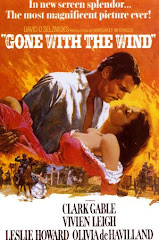
Gone With The Wind (1939)

Director: Victor Fleming
Cast: Vivien Leigh, Olivia de Havilland, Clark Gable, Leslie Howard
Genre: Drama, Romance
Other Nominees: Dark Victory, Goodbye Mr. Chips, Love Affair, Mr. Smith Goes to Washington, Ninotchka, Of Mice and Men, Stagecoach, The Wizard of Oz, Wuthering Heights

This is the most intimidating synopsis I have had to write so far because what more is there to say that has not already been said about Gone With the Wind? If you search the internet you will find an endless sea of praise for this amazing film and in the end I fear that I have very little to add to it. So I will simply do what I can and talk about some of the surprises I found within this brilliant film.

This is an epic film with a run time of almost four hours and in this time we follow the story of one Scarlett O’Hara (Vivien Leigh). When we first meet Scarlett it is 1861 and she is the daughter of a wealthy southern plantation owner. We quickly learn that Scarlett is the center of her own universe, manipulating everyone around her to get her way, and content in the knowledge that every man she meets worships her. But her world comes to an abrupt end when war comes to the South and the Yankee army invades. We watch as she falls into desperate poverty, and then uses her honed powers of manipulation to claw her way out again. As a viewer you build a love/hate relationship with Scarlett, veering from loathing her wicked ways, towards pitying and admiring her resolve and then back to loathing again, and this tug of war on your heart carries throughout the entire film.

After multiple cases of her preying on men, including her obsession with a married man and her continued efforts to steal him away from his wife, you begin to wonder if she is capable of true love at all. When her first husband dies while away at war she laments that her “life is over” because “nothing will ever happen to me again”, clearly being more upset about her status as a widow than about the death of her husband. But beneath her selfish nature we slowly begin to learn that she is capable of loving a man even though her stubbornness leads to her fighting the feeling for almost the entire film.

We meet her true love interest early in the story in the form of the swaggering debonair Rhett Butler, played by Clark Gable. We have seen Clark before on this blog in It Happened One Night and Mutiny on the Bounty but this was clearly the role he was born to play. The single greatest thing about Rhett Butler is that, like Scarlett, he makes no apologizes for what he is. He fraternizes with prostitutes, drinks, smokes, gambles, and is content to do so. He is attracted to Scarlett from the moment he meets her but not for the same reason the other men fawn all over her. He loves Scarlett because he knows her, because in her he sees a female version of himself, and he seems to be the only man who understands what he is up against with her. His immunity to her ways makes for very entertaining interactions. He constantly pokes fun at her and calls her out when she tries to play her mind games and it really is hard not to start enjoying seeing it as much as he enjoys doing it.
Scarlett: Sir, you are no gentleman.
Rhett Butler: And you, Miss, are no lady.

The romance between the two is the central storyline of the film but it is set to an incredibly rich background. After the war starts there are some truly amazing special effects as the city of Atlanta gets bombarded by Sherman and the Yankee army. One scene recalls to my mind as Rhett leads a panicked horse and the ladies through an ammunition dump as explosions happen all around. A many storied building crashes down in flames in front of the party as they desperately try to escape the city. This is a film that cost a staggering 3.7 million dollars to make and in 1939 that was a lot of money! But the investment can be seen throughout as this film really does reach a standard of excellence that is rare in Hollywood.
Gone With the Wind is the first Oscar winning film to be shot in Technicolor, a technique that came with tremendous cost and ate up most of the aforementioned budget. While being the first color Oscar Winning film I was surprised to learn that shooting films in color was a technology that was a around since 1908 but was rarely used because of the expense involved. Hollywood made the first color feature film almost twenty years earlier in 1922 (The Toll of the Sea). This surprised me because most people I know consider The Wizard of Oz to be the first example of color being used in film.

Speaking of Oz it should be said that the nominations list for Best Picture in 1940 was very impressive and the fact that Gone With The Wind came out on top just emphasizes the magnitude of the film. Not only did it beat out Frank Capra directing his usual suspects of Jean Arthur and James Stewart in Mr. Smith Goes to Washington, John Ford directing John Wayne in the classic Stagecoach, but it also beat out The Wizard of Oz itself! Add to that list Goodbye Mr. Chips and Of Mice and Men and to me you have what could be the most hotly contended Best Picture nominations list of all time.

I will leave you with another link to American Film Institutes top 100 movie quotes of all time. I reference the list because Gone With the Wind gets three mentions which again highlights how significant a film this is. Below are the three quotes that made the list and their positions in parenthesis but frankly I think the quote that has the honor of calling itself the greatest movie quote of all time (at least according to AFI) needs no introduction:

As God is my witness, I’ll never be hungry again (59)
After all, tomorrow is another day! (31)
Frankly My Dear, I don’t give a damn. (1)

Full list: http://connect.afi.com/site/DocServer/quotes100.pdf?docID=242

Next Up: Rebecca

Monday, March 8, 2010

2010 Oscars Wrap Up

Reflections:
This year the Oscars was always billed as the epic clash between Avatar and The Hurt Locker. In a way this was the wrong year for the Academy to decide to increase the number of Best Picture nominees to 10. If the goal of this initiative was to widen the scope and give other films a chance at glory it failed because the reality was that Bigelow and Cameron's films were all people talked about.

Personally I was delighted with The Hurt Locker winning the little gold guy. In IMAX 3D, Avatar was an amazing experience, one that left me bewildered and stunned. After watching it I spent days pleading with people to see it as soon as possible. I convinced my colleagues and even my father to go experience it. Whereas on my 40" tv screen at home, and with no surround sound system, The Hurt Locker proved a different visual experience but ultimately a more rewarding one. The dread established in the opening scene stayed with me throughout and when the credits rolled at the end I found myself to be wholly satisfied.

And perhaps that is why The Hurt Locker deserved the glory, because it managed to be just as engrossing a film without relying on CGI, IMAX cameras, or the use of 3D! While Avatar was complete fantasy Hurt Locker was reality and when the dust settles I feel that last night both films got what they deserved. In celebration for the beautiful world that Avatar created it won Cinematography, Art Direction, and Visual Effects. In celebration for the beautiful characters and story that Hurt Locker created it won the crown.

Asides from the center stage fight I thought the categories were very predictable this year. Waltz and Mo'Nique were absolute shoe ins for their supporting roles. In the weeks leading up to the Oscars all I kept hearing was Bridges in Crazy Heart for Best Leading Actor. All three of these examples simply overshadowed their competitors and made for easy guesses.

And while I was left confused at Bullock getting the award for Best Actress (to be honest I was left confused by The Blind Side featuring in the awards period) I can see that she was the popular choice.

Add to these some other obvious picks like the aforementioned artistic awards going to Avatar, Up for Best Animated Feature, and Precious for Best Adapted Screenplay, and you have a gamblers dream! Although I enjoyed this years show to no end I would like to see a closer race in 2011.

Notable Moments:

I have no idea what the story behind this "Kanye" moment was but while a pleasant speaking chap accepted the award for Best Documentary Short a rather obnoxious lady bulldozed her way onto the stage! The link below has details of the childish squabble..
http://www.popeater.com/2010/03/08/music-by-prudence-elinor-burkett-oscars/

I thought it was a nice moment when Jim Cameron immediately stood and clapped after his ex-wife's film won Best Picture. All is fair in love and war.

Ben Stiller as a N'avi! The comedy moment of the night came not from Martin or Baldwin but from Ben Stiller and a fishing rod!
http://www.youtube.com/watch?v=3SG-H7G4IWg

All Winners:
Best Picture -- The Hurt Locker

Actor in a Leading Role -- Jeff Bridges (Crazy Heart)

Actor in a Supporting Role -- Christoph Waltz (Inglorious Basterds)

Actress in a Leading Role -- Sandra Bullock (The Blind Side)

Actress in a Supporting Role -- Mo'Nique (Precious: Based on the Novel 'Push' by Sapphire)

Animated Feature Film -- Up

Art Direction -- Avatar

Cinematography -- Avatar

Costume Design -- The Young Victoria

Directing -- Kathryn Bigelow (The Hurt Locker)

Documentary Feature -- The Cove

Documentary Short -- Music by Prudence

Film Editing -- The Hurt Locker

Foreign Language Film -- The Secret in Their Eyes (El Secreto de Sus Ojos)(Argentina)

Makeup -- Star Trek

Music (Original Score) -- Up

Music (Original Song) -- "The Weary Kind" (Crazy Heart)

Short Film (Animated) -- Logorama

Short Film (Live Action) -- The New Tenants

Sound Editing -- The Hurt Locker

Sound Mixing -- The Hurt Locker

Visual Effects -- Avatar

Writing (Adapted Screenplay) -- Precious: Based on the Novel 'Push' by Sapphire

Writing (Original Screenplay) -- The Hurt Locker

Tuesday, March 2, 2010

Top 3 -- Best Picture Oscar Winning Movies from the 1930s

Here is my pick of the litter from the 1930s:


3rd place
1935 Mutiny on the Bounty
Mutiny on the Bounty surprised me for a lot of reasons... the special effects, the adventurous storyline, the courageous performance from Clark Gable, etc. But the first and foremost reason is Charles Laughton as Captain William Bligh! By playing this character Laughton deserves recognition for bringing to life a villain of equal stature to Darth Vadar, Hannibal Lector or any other malevolent screen creation you can think of. He is simply an evil incarnation of a man and I too wanted to mutiny against his wicked ways!


2nd place
1930 All Quiet on the Western Front
Any preconceptions I had of older movies lacking the ability to shock and stun you were blown away by this truly guttural experience. The psychological horrors of the first World War are brutally portrayed in this film and it is such a shame to think that its release came only years before the world was embroiled once more in another great war.


1st Place
1939 Gone With The Wind
It would be very difficult to suggest another movie from this decade that deserves the top spot. After all, this is a movie that makes a lot of top 10 films of all time lists, never mind just of the 1930's. If you have not seen it then shame on you. 

You Can't Take It With You (1938)

Director: Frank Capra
Cast: Jean Arthur, Lionel Barrymore, James Stewart, Ann Miller
Genre: Comedy
Other Nominees: The Adventures of Robin Hood, Alexander’s Ragtime Band, Boys Town, The Citadel, Four Daughters, Grand Illusion, Jezebel, Pygmalion, Test Pilot

The 1930s was a very successful time for Frank Capra. We had already seen him direct the 1935 winner It Happened One Night and here we again see him direct the last Best Picture winning film of the decade, You Can’t Take it With You. These two movies have a lot in common. They are both romantic comedies and both pictures feature two young lovers from opposite classes. Most of the comedy found in these films is born from the clashing of the classes as the snobbish members of the bourgeoisie are forced to share tables with the common people. But as the title suggests, You Can’t Take it With You also carries with it some important life lessons.

The film centers on an unusually friendly and welcoming Sycamore family who have abandoned the grind of modern life and devoted themselves to doing what they want to do. The grandfather and head of the family, played by Lionel Barrymore, is the driving force behind this radical approach to life. He talks about how he was a successful business man who one day rode the elevator up to his office and then right back down again, deciding then and there to never set foot inside the building again. He instead turned to a life of stamp collecting and of having fun. The collective family all embody this freewheeling attitude to life with a wide variety of hobbies from chocolate making, to ballet lessons, to writing, to the manufacturing of firecrackers! A constant swarm of activity results from them all living under one roof and practicing these hobbies in a confined space. A framed “Home Sweet Home” picture constantly falls from the wall and is hung back up by various characters throughout the movie and emphasizes the fact that this is a bustling, crazy place to live but also a place filled with love and warmth. Members of this household are rarely stressed, not even when Internal Revenue officers stop by for a chat, as we see in one scene. It quickly becomes equally as uplifting an experience to watch the activities of this family as it appears to be to live with them there.

The youngest of the family is played by the gorgeous Jean Arthur and she has fallen for son of a banking magnate played by James Stewart. The two are very much in love and perfect for each other but both are struggling with the concept of their families meeting. Opposing the gleeful utopia of the Sycamore family is the wealthy Kirby family who embody everything that the Sycamore family values are against? As you can expect the meeting of the two represents an enormous challenge for the Kirbys but also offers them a chance to evaluate their own happiness and their own way of life. In the end the film is as much an education for us as it is for the wealthy banker and his wife, and it is fitting that the title words are spoken by Grandpa to Mr. Kirby in an effort to make him, and us, see that money is not all there is in this world. There are more important things to invest your time in.

The other Capra film I am familiar with is, of course, It’s a Wonderful Life (1946). I mention it as it too shares commonalities with You Can’t Take it With You. Asides from starring the same lead actor, James Stewart, it also delivers that great message that friendships and kindness to others will in the end make you richer than any amount of money will. They are both movies that warn against a life of greed and suggest that you instead focus on building relationships with people. Interestingly enough, both movies also feature a very similar scene where the respective townsfolk enthusiastically gather money to help out (or bail out as the case may be) the main characters who they hold dearly. I have always been a huge fan of the famous Christmas movie and of this heartwarming scene but I have to say that after viewing You Can’t Take it With You I think that this earlier film does a better job at delivering the overall message of goodwill towards all.

I would like to finish on a different note. I found it fascinating how the threat of Communism was already rearing its head in the late 1930’s and is very present in this movie. I should make the point that the film does not demonize Communism and simply shows how the Sycamore family, in all of their innocence and love for life, become suspected of being Communists. It is a shame that the very things that should be admired in a family like putting each other first, being fun loving, happy, and welcoming to all people, are the things that bring them under suspicion. Grandpa quotes Lincoln when describing the family’s attitudes: "With malice toward none, with charity to all". The film tries to show that we should not judge everyone who is different as being evil but more impressive is that it tries to show this in a time when being different did result in a lot of scrutiny. I imagine that this film ran the risk of being very unpopular. I have pulled some dialogue from the movie where Grandpa talks to his daughter about what he calls “ism-mania”, a trend he sees all around him:
Grandpa: Penny, why don't you write a play about Ism-Mania?
Penny: Ism-Mania?
Grandpa: Yeah, sure, you know, Communism, Fascism, Voodoo-ism, everybody's got an -ism these days.
Penny: Oh [laughs] I thought it was some kind of itch or something.
Grandpa: Well, it's just as catching. When things go a little bad nowadays, you go out, get yourself an -ism and you're in business!

I think I should applaud the Academy for recognizing a comedy that, under the surface, is tackling such a great societal problem.

Next Up: Gone With The Wind